Barring the Pros Didn't Make This Fair. It Made It Honest.
A $500,000 heads-up tournament with no professional players pays fourth place more than a real Main Event paid for outlasting 278 people. Nobody planned that as an insult. That's what makes it worth sitting with.
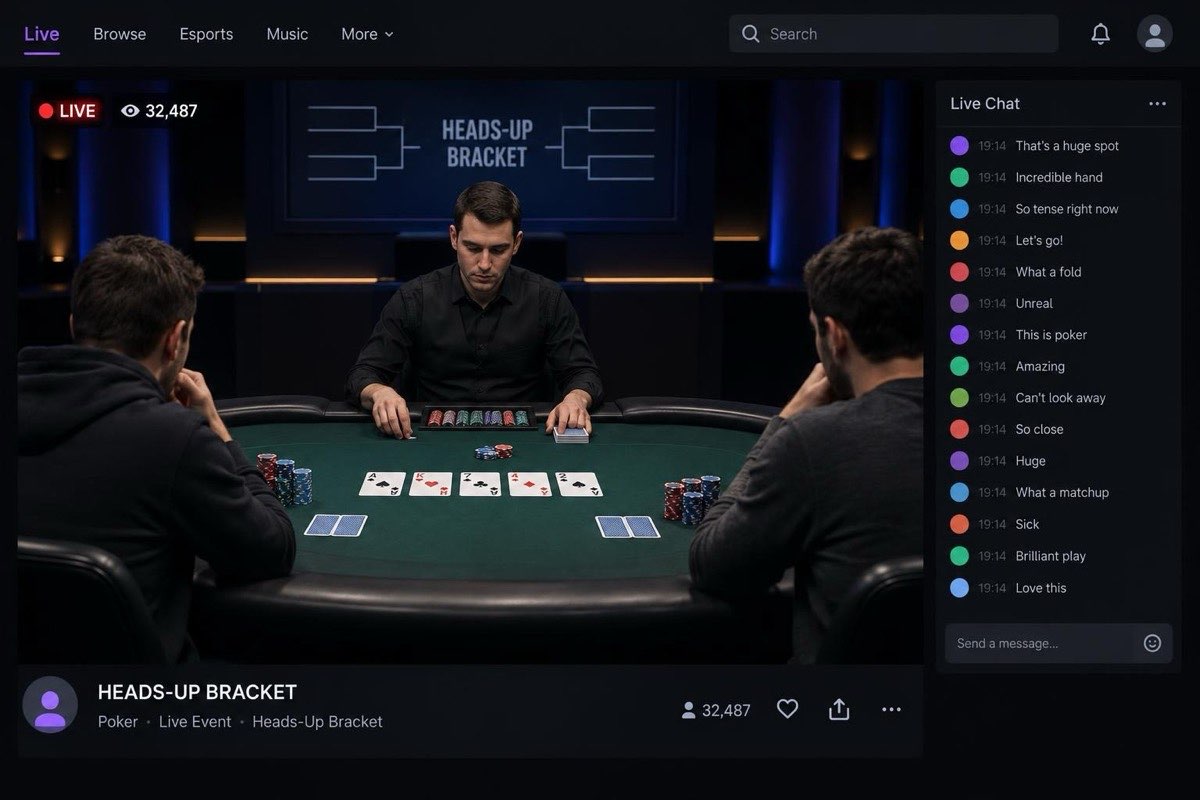
Poker Champs runs September 19 to 26: eight players, a straight heads-up bracket, $500,000 total, hosted by ClubWPT Gold and commentated by Doug Polk. Alexandra Botez, xQc, sodapoppin and erobb221 are four of the eight confirmed names. None of the eight will be a professional poker player - the format bars them explicitly. First place takes $250,000. Fourth place, the tournament's min-cash, takes $50,000.
On Saturday, in an actual poker tournament with no streaming deal attached to it, Grant Hart outlasted 278 entries in New Orleans and won $44,000.
Those two numbers sitting next to each other aren't a scandal, and it's worth saying that plainly before going anywhere else with them. They aren't really about the eight streamers either, none of whom set the prize pool themselves and none of whom decided what an audience is worth watching. But the numbers are still the story, because they're the first time anyone's put a real, comparable dollar figure on the actual gap between "plays poker well enough to outlast 278 entries" and "poker fans will watch this specific person play," and the gap isn't close. Fourth place in an eight-person exhibition, with no field to beat and no bracket depth to speak of, outpays a genuine field win by more than six thousand dollars.
A Production Decision, Not an Insult
Barring pros from Poker Champs wasn't framed anywhere as an insult to professional players, and it almost certainly wasn't intended as one. Read as a production decision it makes complete sense: a bet that eight familiar faces with existing built-in audiences draws bigger viewing numbers than eight unknown grinders would, regardless of which group plays the technically better heads-up poker. That bet is probably correct. Streamers with six- and seven-figure follower counts bring an audience with them into the broadcast in a way that a field of anonymous-to-the-public regulars simply can't, no matter how sharp their game is.
That's also the uncomfortable part, and it's worth sitting with rather than rushing past. The tournament didn't need to exclude professional players to prove that poker skill isn't the primary thing being monetized in this particular format. It excluded them because, for what this event is actually selling, it didn't need them at all - the audience isn't tuning in to evaluate heads-up play at a technical level, it's tuning in because it already follows Botez or xQc or sodapoppin somewhere else. Fifty thousand dollars for a min-cash, against forty-four thousand for outlasting 278 real opponents, is the receipt for that calculation, itemized in dollars rather than left as a vague sense that something's shifted.
Nobody rigged anything here. The money simply went where the audience already was, and the audience was never primarily watching for the poker.
What the Gap Actually Measures
It would be easy to read this as a straightforward decline-of-the-pro narrative, poker eating itself, content winning out over competition, and there's something to that reading. But it's worth separating two different things that are easy to collapse into one complaint. The first is whether streamer-driven exhibition formats pay more than traditional tournaments relative to field size and skill required - on Saturday's numbers, clearly yes, and dramatically so. The second is whether that's actually bad for the pros the comparison seems to slight. A lot of the eight-figure names skipping traditional structures for exhibition formats like this one are the same players who've spent years building the audiences that make formats like Poker Champs commercially viable in the first place. The gap in payout isn't purely extracted from poker's traditional economy; some of it is new money that traditional tournament poker was never going to attract on its own; a $500,000 exhibition bracket with Doug Polk on commentary and four established streaming names is bringing eyeballs to the game that a 278-entry New Orleans field, however legitimate, simply wasn't reaching.
None of that erases what the two numbers actually say when placed side by side, and none of it means the comparison isn't worth making. Grant Hart beat 278 real opponents across a real tournament structure and made $44,000 for it. Whoever finishes fourth out of eight in an exhibition bracket with no field to speak of will make more than that simply for not being eliminated third. Nobody has to like what that says about where the money in poker is actually pointed right now, or pretend it's a permanent state of affairs rather than a snapshot of one particular week. It's just increasingly hard to argue with the math sitting directly next to itself.
There's also a version of this that traditional tournament poker could learn from rather than simply resent. Grant Hart's $44,000 didn't come with a broadcast, a build-up, or eight familiar faces the audience already followed into the room. The New Orleans field did exactly what a tournament is supposed to do: took 278 entries, paid out according to how deep each of them ran, and crowned a winner on the merits, with no committee deciding in advance who the audience should already care about. That structure is the entire reason poker has any claim to being a sport rather than a broadcast product in the first place, and it's worth defending on those terms even while admitting it currently pays worse for a real accomplishment than an exhibition bracket pays for surviving three rounds against seven other streamers.
The two formats aren't actually competing for the same thing, whatever the dollar figures make it look like from a distance. One is selling a competition. The other is selling eight people an audience already wants to watch, with a poker tournament as the vehicle. Comparing their prize pools tells you something real and worth knowing, but it doesn't tell you which one poker needs more of, and it's worth resisting the urge to answer that question just because one number happens to be bigger than the other this particular week.