The Cheap Tournament Is the Expensive One
A decade of rake data landed this week, and it says the same thing every recreational player already suspected: the smaller the buy-in, the bigger the cut.
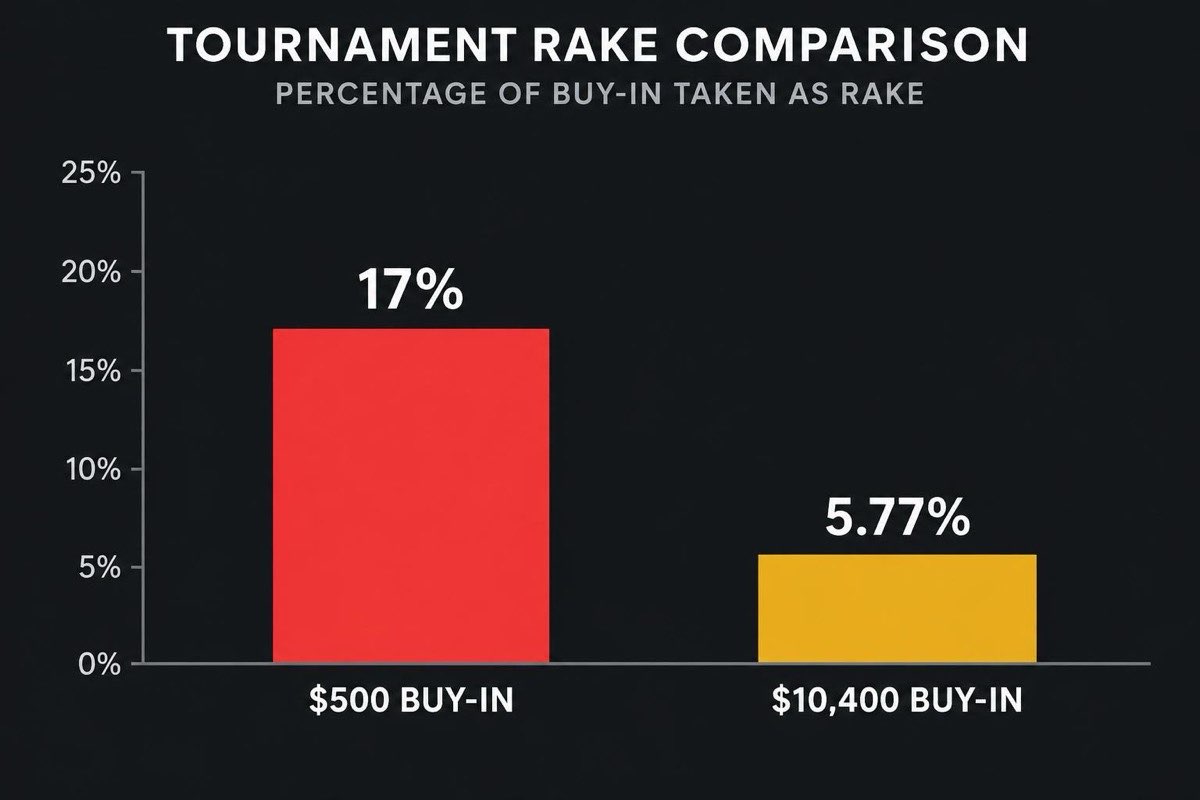
In 2015 the WSOP's $500 Colossus took 11.5 percent of the prize pool as rake. It takes 17 percent now. A Seminole Hard Rock Hollywood multi-flight around $400 went from 14.29 percent to 18 over the same stretch. The WSOPC's own $400 multi-flight has held at 17.5 percent for years, which in this company reads less like a number and more like restraint.
Now the top of the market, over the identical decade. The WSOP Main Event, ten thousand dollars to enter, went from 5.99 percent to 7 - barely moving, and mostly explained by rising overhead rather than the operator suddenly deciding to take more. The WPT's $10,400 Championship actually dropped, from 6.73 down to 5.77. EPT Prague's 5,300-euro Main Event hasn't moved off 8.49 percent in eleven years. Whatever else has changed in tournament poker since 2015, the rake charged to the people paying five figures to play has stayed almost perfectly still.
The Shape the Numbers Draw
Line all of that up and the shape draws itself without needing much commentary. Rake at the top of the market has been essentially flat for a decade, or falling. Rake at the bottom has climbed by as much as six full points over the same window. The data was first assembled after Patrick Leonard publicly asked last October whether anyone had actually run these numbers across a decade rather than trading impressions about them, and once someone did, it confirmed the thing every $500 grinder already felt without being able to prove: the cheap seat is the one subsidizing the room.
It isn't a conspiracy in the sense of anyone sitting in a room deciding to squeeze the small buy-ins specifically. Rake at the bottom of the market has always run structurally higher than rake at the top, because fixed operating costs (staff, tables, dealers, the building itself) get divided across a much smaller prize pool when the buy-in is $500 instead of $10,400. That part isn't new and isn't really in dispute. What's new is the decade of data showing that gap widening rather than holding steady or narrowing, at exactly the moment the smaller buy-ins are the ones bringing in the players an operator most needs to keep coming back.
A rake structure doesn't have to be a conspiracy to be a decision. Somebody chose to let the gap widen for ten straight years instead of closing it, and nobody had to sign anything to make that choice.
The Advice That Can't Reach the People Who Need It
The standard advice for a player unhappy with a bad rake structure is to move up: sell some action, find the bigger buy-in where the percentage is kinder, stop playing in the field that's taking 17 or 18 points off the top. It's true as far as it goes, and it's advice that specifically cannot reach the people actually paying that 17 and 18 percent, because the entire reason they're sitting in the $400 flight and not the $10,400 Championship is that the larger buy-in was never realistically on the table for them in the first place. Telling someone who's priced out of a market that the fix is to spend more money in that same market isn't really a fix. It's the problem, said back to the person already living inside it, dressed up as a solution.
None of this means the $10,400 field is somehow the villain of the story, or that operators are pocketing some enormous secret margin at the low end that they aren't at the high end. Running a $500 tournament genuinely costs more per dollar of prize pool than running a $10,400 one, and a rake number by itself doesn't say anything about profit margin without knowing the actual cost structure behind it, which this data doesn't include. What the decade of numbers does say, cleanly and without needing a margin figure to make the point, is that the gap between what the smallest buy-in pays and what the largest one pays has been allowed to widen for ten consecutive years, in an era when tournament poker has never had better tools for measuring exactly what it's charging whom.
The WSOP Main Event has lost entries two years running now, a fact that gets discussed constantly and explained a dozen different ways depending on who's doing the explaining. Nobody involved is treating the entries decline as a coincidence sitting next to this rake data, and this is the first real numbers anyone's actually published connecting the two. It doesn't prove causation on its own. It does mean the next person who wants to argue there's no connection has to argue against an actual decade of figures instead of a hunch, which is a meaningfully different conversation than the one the room has been having until now.